 Por mariogarcia
 Last December I joined a program. This week Oracle told me to stay in it. And even though on paper it looks like nothing changed, it did.
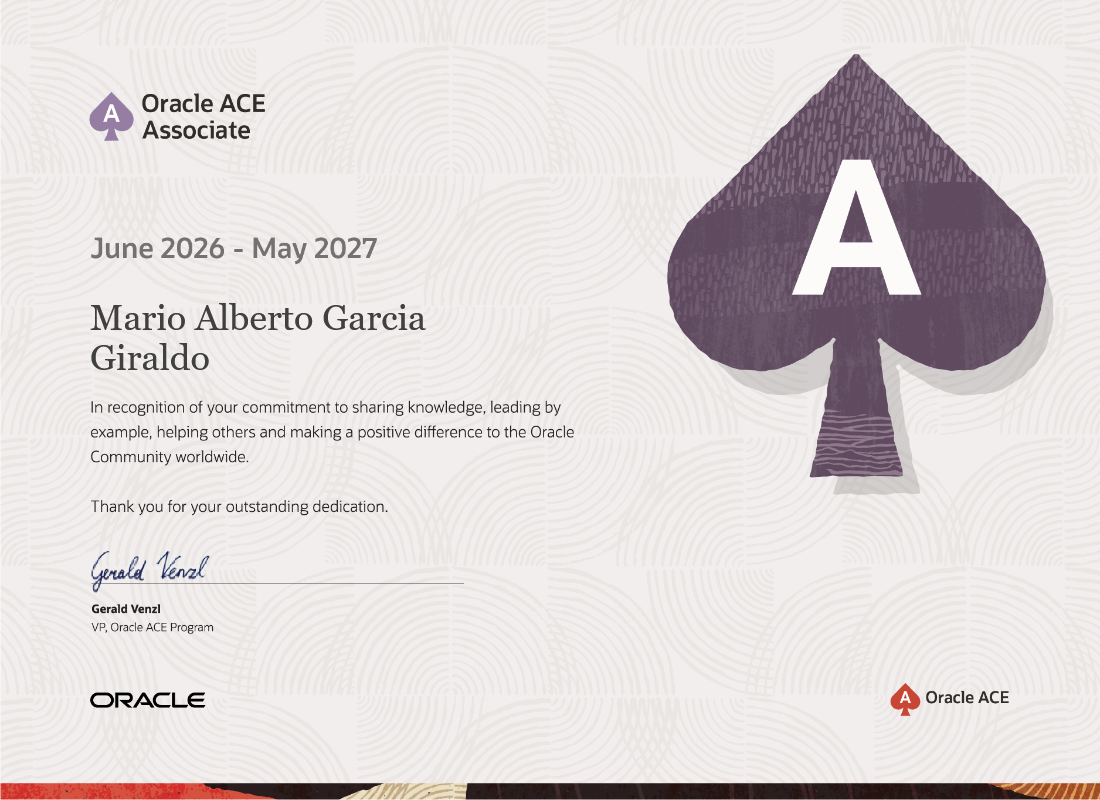
I’ve been renewed as an Oracle ACE Associate. I didn’t move up a tier. And let me tell you why that, far from bothering me, feels like the best professional news of my year.
The trap of wanting to climb fast
To qualify for Oracle ACE Pro you need more than eight months inside the program. I started in December. Do the math: the calendar simply wasn’t on my side. So this cycle I renew as Associate, and next year I’m going all in for Pro.
I could have taken it as a setback. I see it the opposite way. The program doesn’t reward a single bright flash. It rewards sustained consistency. It rewards showing up, writing, teaching, and solving real problems when nobody’s watching anymore.
And that, it turns out, is exactly what makes a JD Edwards automation actually work.
The problem nobody mentions before you automate
The JDE ecosystem is full of gorgeous demos. An Orchestrator that performs magic in fifteen minutes over a clean screen, with perfect data and not a single exception.
The problem shows up in production. The vendor invoices you, the flow goes live, and three months in something shifts: a new business condition, an array that no longer arrives the way it used to, an edge case nobody planned for. And that brilliant-looking Orchestrator starts breaking every month-end.
That’s when you discover the difference between someone who can chain tools together and someone who understands JD Edwards from the inside. The first one sells you speed. The second one saves you the fires.
Oracle’s recognition isn’t about ego. It’s about that: pointing to who has proven, over months and in front of the community, that they know what they’re doing when the real case gets messy.
Where AI comes in (and where it shouldn’t)
Since December I’ve been defending an idea that makes some people uncomfortable: AI doesn’t replace JDE knowledge, it multiplies it.
When I use a model to generate a Groovy script inside a Custom Request, I’m not asking it to guess my business. I’m asking for a starting point. The rest comes from domain knowledge: the native method signature, null and empty handling, named variables, the writeDebug and writeWarn logging so that when something fails at two in the morning there’s a trail and not a mystery.
AI speeds up the mechanical part. The judgment of what to automate, how to chain the Orchestrators, and where to validate the business rule stays human. And it’s precisely that judgment a badge like Oracle ACE is trying to certify.
What this means for your business (the part that matters)
Here’s the translation into money, which is the only thing that truly matters in a boardroom.
A well-designed Orchestrator for validating and distributing sales data can turn a manual process of several hours a week into something that happens by itself, in seconds, with nobody copy-pasting between screens. Multiply that by fifty-two weeks and by the cost of a qualified profile, and the saving stops being a technical detail and becomes a visible line in the budget.
But the big saving isn’t that one. The big saving is the error that never happens. A transaction launched wrong in JDE doesn’t cost hours: it costs rework, mismatches, reconciliations, and sometimes client trust. Reliable automation isn’t just faster; it’s more correct, and correctness in an ERP is cash, plain and simple.
When you choose who you trust that automation to, you’re not hiring a script. You’re hiring the probability that the script still works a year from now. And that probability is built over time, not in a demo.
Why this renewal is about you
If you’ve followed my content over this time, this renewal is as much yours as it is mine. Every article, every email, and every post came out of a conversation, a question, or a real problem someone in this community brought to me.
Sharing technical knowledge doesn’t shrink my advantage. It creates it. Because knowledge that stays locked in one person’s head is a risk to the organization; knowledge that’s shared and recognized compounds.
So thank you. Truly. We’re going for ACE Pro next year, but with no rush for the badge and full focus on solving things that actually matter.
If your company is automating JD Edwards with Orchestrator and you want to do it in a way that survives month three, month six, and the full year, let’s talk. Architecture design, consulting, and complete Orchestrator training: the same thing I’ve been writing about here for months, applied to your case.